
.
HOORAY FOR HOLLYWEIRD
It long ago occurred to me that Hollywood (as opposed to West Hollywood) must almost assuredly be the single most disappointing tourist destination in the entire world. True, in Hollywood you’ll find the famous Chinese Theatre, where so many movie premieres took place during Hollywood’s “Golden Era” and the hand and foot prints of past stars are preserved in the courtyard entrance; and yes, you’ll find the well known “Walk Of Fame”, where the names of celebrities are embedded in stars that are embedded in the Hollywood Blvd. sidewalk.
And that’s about all you’ll find that is noteworthy in this run-down, grimy part of town with it’s cheap souvenir shops, liquor and dirty book stores.
And the biggest disappointment of disappointing Hollywood must certainly be the world renowned intersection of “Hollywood And Vine”. How many tourists from Iowa and Nebraska must have traveled all the way to Hollywood And Vine, thinking they might see celebrities walking the streets there, only to find that they, the tourists, were the classiest, most wealthy looking people at the intersection.
Here’s all you’re likely to find strolling the vicinity of “Hollywood And Vine”: Pimps, Prostitutes, Drug Addicts, Winos, Teen Runaways, Stray Dogs and Feral Cats. Tom Waits was close to the truth when he renamed the intersection "Heartattack And Vine".
Below is a photo of the world famous Hollywood And Vine intersection. A block north of Hollywood on Vine is the unique Capitol Records building, looking like a stack of records with a needle on top. Otherwise, this is just a filthy little meeting of old streets.
.

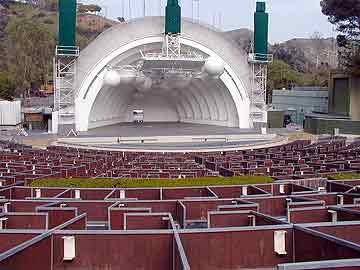
Well, OK, yes, it's also true that you'll find The Hollywood Bowl in

The Beatles at The Bowl:
http://www.youtube.com/watch?v=0Ve-MAfdahI&NR=1
In his lyrically masterful song “Emotional Weather Report”, Tom Waits tells us that “It’s colder than a ticket-taker’s smile at the Ivar Theatre on a Saturday night.” That’s a brilliant line, particularly when you’re aware that at the time Waits wrote it, the Ivar Theatre, located in grungy Hollywood

A lot of musicians are generally thought of as being associated with the city of L.A. One of the more successful bands was The Doors. In 1985, 14 years after lead singer Jim Morrison’s death, keyboardist Ray Manzarek directed a video for the classic Doors’ song “L.A. Woman”. Here’s that video, which captures the Hollywood scene better than does that brochure you got from your travel agent in Omaha. [Watch for the cool ‘L.A. Signs Segment’, which includes my Downtown “Jesus Saves” sign mentioned in Part 1.] :
http://www.youtube.com/watch?v=b-wgIht3roA&NR=1
Below is the “EGENDS OF HOLLYWOO” photograph of me. It was taken in front of a large Hollywood mural. Look closely and you’ll see me standing in the bottom right corner in front of a partially visible painting of James Dean:

One night in 1981 or '82, my friend Dean and I went cruising the crappy streets of Hollywood, listening to Bruce Springsteen's first album, in Dean’s VW van. We’d pull up to the curbs and I’d light the firecrackers and toss ‘em out at the feet of pimps standing on the street corners. One pimp actually gave chase, but a well-timed U-turn in a busy Hollywood intersection finally shook him off our trail. FUN! [Dean at left in the photo below, me on the right.] :

High in the hills above Hollywood stands the "Hollywood Sign". Along with the Statue Of Liberty, the Liberty Bell, and Mount Rushmore, it is one of the most universally recognized icons of the United States. :
.

On New Year’s Eve 1979, I sneaked up to the Hollywood Sign for the first time, and I touched every letter. I was up there alone in the dark when struck and the ‘80s began, telling myself that this was destined to be my decade; before it was over, everyone would know the name of the actor Stephen T. McCarthy. WRONG!
.
.

Over the years, I took various groups of friends up to the Hollywood Sign with me, but one of the more memorable episodes was that same night that Dean and I drove around Hollywood, throwing firecrackers at pimps. When we got tired of that sport, we bought a bottle of whiskey, jumped the fence, and hiked up to the Hollywood Sign.
At the moment the sun came up over Downtown L.A., Dean and I were side-by-side, hanging over the crossbar in the middle of the letter “H”, passing the whiskey bottle back and forth and talking about the big plans we had for the future.
Below is a rare photo taken from behind the Hollywood Sign and showing you the view south. That’s what Dean and I could see, as we hung drunkenly from the center of the first letter in "Hollywood". In the distance on the left, you can make out Downtown Los Angeles:
.

The sordid underbelly of the Hollywood / Los Angeles scene was never better captured than in the songs found on the first and only David & David album "Boomtown".
Few Rock stars really have anything meaningful to say, but David & David not only had something authentic to say, but they said it with skill, creativity, and imaginative musical arrangements. “Boomtown” was one of the best debut music albums ever released by anyone, and it perfectly captured my mood in 1986. It speaks of angst, depression, failure, hope, and feeling “All Alone In The Big City”.
Here's a video for the title track, filmed in various L.A. locations. It'll teach you what sort of sound money makes. [That gal being helped out of the limousine isn't feeling any pain, is she?] :
.
http://www.youtube.com/watch?v=97wvwuHUMCw
WEST HOLLYWEIRD - WHERE THE REAL ACTION IS
All the native Angelenos like me know that there is a distinction to be made between “Hollywood” and “West Hollywood”. West Hollywood is generally that part of the Hollywood district of Los Angeles that lies West of La Cienega Boulevard (or Fairfax Ave. to be more technically correct and generous).
This is the home of the legendary “Sunset Strip”, where you’ll find famous music venues like The Roxy, and the Rock star hangout, The Rainbow Bar [both seen in the Sunset Boulevard photo below] :

Sunset Blvd. in West Hollywood is also home to the famous Whisky-A-Go-Go, a nightclub with a rich musical history dating back to the Psychedelic ‘60s. Every band on its way up has played “The Whisky”. I saw a number of bands there in my day, one of them being The Police, as their song “Roxanne” was just beginning to get a little airplay on the L.A.

It's on Sunset Boulevard in West Hollywood where you really might see celebrities walking along the street, drinking in the bars, or eating in the restaurants. You won't necessarily see Jesus there, but you might see a famous actor or actress with an expensive cocaine habit. :

And certainly you will see Rocky and Bullwinkle on Sunset Blvd. A statue of them stands in front of the production office where the all-time greatest cartoon was fashioned. (At least I hope it's still there.)

Anyone remember Sweet’s big mid-‘70s hits, “Fox On The Run” and “The Ballroom Blitz”? Both songs came from their "Desolation Boulevard" album. And pictured behind the band on the album cover was a segment of Sunset Boulevard in West Hollywood . So, the truth is out: "Desolation Boulevard = Sunset Boulevard”. Perhaps now you’ll be able to get some sleep. :

The Hyatt House hotel is on Sunset Blvd. right where La Cienega meets up with it. Innumerable Rock stars have stayed here, and back in the days when you would find Jim Morrison, the Rolling Stones, and Led Zeppelin smashing its rooms, the place was nicknamed "The Riot House".
The post-tour party that the blokes from Spinal Tap attend at the end of the movie "This Is Spinal Tap" was filmed on the roof of the Hyatt House. I just happened to recognize the swimming pool and the roof area.
Because of his sardonic wit and twisted humor, and his ability to really turn a memorable phrase, one of my favorite musicians associated with the city of Los Angeles was Warren Zevon. In his song "Poor, Poor Pitiful Me", Zevon sings:
“Well, I met a girl in West Hollywood / I ain't naming names / She really worked me over good /She was just like Jesse James ... Well, I met a girl at the Rainbow bar / She asked me if I'd beat her / She took me back to the Hyatt House / I don't wanna talk about it.”
Ha! You gotta love it!
.
Below is the Hyatt (Riot) House:
.

Also on Sunset Blvd. is the "Sunset Grill", the subject of Don Henley's song of the same name. I remember the night in 1985 or '86 that my friend Lin Coleman and I were driving around town with an open keg of beer in the back seat of her VW bug (the mother of all "open container" charges). We pulled up to the curb right in front of the Sunset Grill to pour ourselves another beer.
That's where we were when Lin - who was in film school - finally talked me (who apparently had consumed a beer too many) into playing the lead role in the screenplay about Jim Morrison, which I had written for her film school final project. It was the last bit of acting I ever did, and called it quits immediately after filming was completed.
Incidentally, Lin went on to become a film editor in Hollywood and her credits can be found HERE.

Below is a photo of L.A.

THE TROUBADOUR is a live music venue on Santa Monica Boulevard in West Hollywood. In the late '70s, my friend Eric and I practically lived in this club on the weekends. The Rock music and entertainment history of this place is absolutely incredible. Click the link below the photo and check out all the stuffs that The Troubadour is known for.
But just for starters, here are some events that occurred at “The Troub”: Lenny Bruce was once arrested; the members of the Byrds first met there; Joni Mitchell made her L.A. debut there; Cheech and Chong were discovered there; Janis Joplin partied there the night of her death; Tom Waits was discovered; Van Morrison recorded some of his live album “It’s Too Late To Stop Now” there; Don Henley first met Glenn Frey at one of The Troubadour's bars, and John Lennon got thrown out of The Troubadour one night. And that’s just a small taste of The Troub’s rich history:

http://www.troubadour.com/histor
"The Sad Cafe" is a song by the Eagles about the golden years of Doug Weston's 'Troubadour'.
In the liner notes to the CD set "The Very Best Of The Eagles", Glenn Frey wrote the following about "The Sad Cafe":
The title comes from the book by Carson McCullers. I love the title, which didn't have anything to do with the song, other than it was a great title. The line that really resonates for me in that song is "I don't know why fortune smiles on some and lets the rest go free."
There were so many of us aspiring musicians hanging around at the Troubadour. Some nights when Doug Dillard got drunk enough, and Gene Clark got drunk enough, and Harry Dean Stanton got drunk enough... near closing time... they would all start singing. There would be these unbelievable impromptu versions of "Amazing Grace" -- all sorts of Ozark spiritual things with the whole bar singing...
That stuff really happened. We were getting older (when we wrote the song), and there was a sadness because we had seen, close-up, that everybody's dreams don't come true. Or, at least, not in the way they think they're gonna come true.
And Don Henley had this to say about it:
A train used to run down the center of Santa Monica Boulevard, right outside the Troubadour. Steve Martin actually had a routine where he'd get the entire audience to exit the club, hop a flatcar on that slow-moving train and ride up to La Cienega, a few blocks east. Then, everybody would hop off and walk back down to the club together.
I don't think that happened very many times -- maybe not even more than once or twice, because the railroad people didn't like it. It was kind of dangerous and there was liability involved. Still -- and I don't want to over-mythologize -- it was something to remember. That was a wonderful time in Los Angeles. The city was alive with magic and a sense of possibility. People were warmer and more open than they are now.
Then, of course, there was the dark side. Friends and acquaintances of ours (from that era) had begun to meet untimely ends -- classic cases of "too much, too soon." It was either that or "too little, too late." So we were struggling to make sense of that dichotomy, that contradiction. Is fortune a good thing or a bad thing, you know? Is being fortunate, before you're ready to accept it and deal with it, actually fortunate -- or is it unfortunate?
We were struggling with our own success -- riddled with feelings of guilt and unworthiness. I think a lot of young artists feel that way. We always identified with that great song "Fakin' It," by Paul Simon. It takes many years and lots of experience for a man to get comfortable in his own skin. But the Troubadour, Dan Tana's restaurant, the train -- all those things served as a great metaphor for the search, the journey that so many of us were on.
I can fully understand the feeling that Don Henley is attempting to express. But for me, the basis of that feeling - those magic memories - are associated more with a group of guys than it is with one particular place. The guys called themselves "The League Of Soul Crusaders", and I'll expound more on them in the next installment.
At the opposite end of the spectrum from The Troubadour, and in West L.A. rather than in that district of L.A. known as West Hollywood, was CLUB 88 :

CLUB 88, where a lot of non-talent-havin’-Punk-bands pulled the wool over the glassy-eyes of a lot of non-brain-havin’-teenagers of Los Angeles. Heck, I once even saw my own Cousin sing there with his band 'Sex And Violins'. That was before my Cousin sold his soul to the devil and suddenly showed up at my apartment one day with a tape of new songs recorded with his new band, The Zone, and his vocals and his band blew me away.
It was suddenly apparent to me that my Cousin was a REAL singer/songwriter and that he had far greater than Club-88-level talent!
Jim Morrison had summed up the entire Punk Rock movement message in two sentences nearly a decade earlier, and he expressed it far better than any of the countless, talentless Punk Rockers ever did:
“I woke up this morning and I got myself a beer.
The future’s uncertain and the end is always near.”
~ Jim Morrison in ‘Roadhouse Blues’
I never once met a Punk Rocker who wasn’t a poseur.
Transport yourself to Part 5 by clicking here: The Waybac Machine
~ Stephen T. McCarthy
YE OLDE COMMENT POLICY: All comments, pro and con, are welcome. However, ad hominem attacks and disrespectful epithets will not be tolerated (read: "posted"). After all, this isn’t Amazon.com, so I don’t have to put up with that kind of bovine excrement.
.
.


